
There is a brief moment in autumn when the year seems to pause. Summer has not completely disappeared, but the light is changing. Evenings arrive earlier, mornings feel different, and the landscape slowly begins to turn inward.
Mabon arrives at this point of transition, marking the autumn equinox and the second harvest. It brings a moment of near-equilibrium between light and darkness, before the balance tips toward longer nights. For me, it feels less like an ending and more like a recalibration, a moment to notice that what worked through summer may no longer work in quite the same way.
The shift can be subtle. Sleep patterns change, energy fluctuates, and the desire to stay constantly active may soften. Mabon invites us to notice these changes and ask not how much we can keep doing, but what needs to be adjusted so we can continue sustainably.
🌙 What is Mabon?
Date: Around September 21–23, marking the autumn equinox, when day and night are close in length. It represents a turning point between the brighter and darker halves of the year, as daylight continues to decrease and the natural world begins its transition toward dormancy.
🌿 Origins, Historical Roots and Meaning
Mabon as a named festival is modern. In the 1970s, American Pagan author Aidan Kelly gave the autumn equinox the name Mabon as part of the developing modern Wheel of the Year. The equinox itself, however, is an ancient astronomical marker, and seasonal harvest traditions surrounding this time of year are much older.
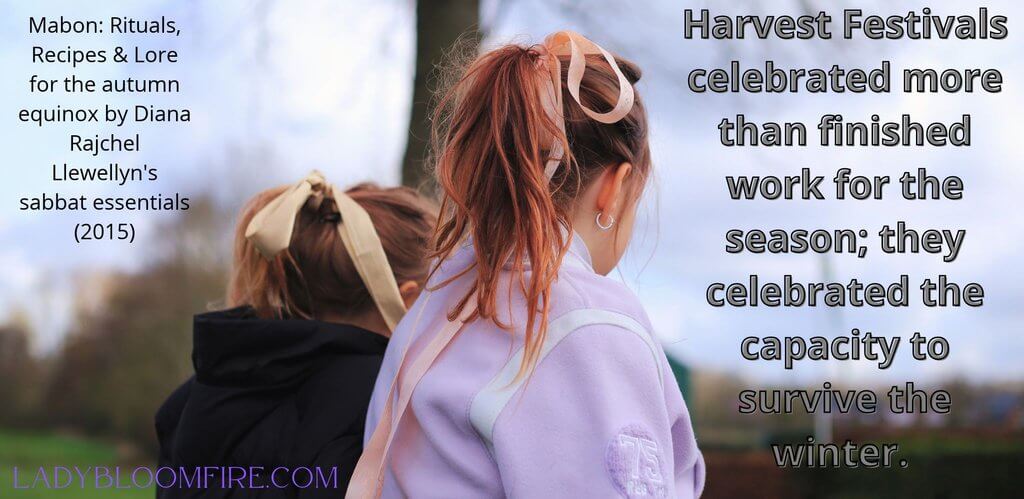
Across Europe, the period around the autumn equinox was connected with the gathering and completion of the harvest. In England, Harvest Home, also known as the Ingathering, referred to celebrations held when the harvest was brought in. These were deeply communal occasions, marking the end of an intense period of agricultural labour and the securing of food for the months ahead.
In Germany, Erntedank traditions developed around giving thanks for the harvest, often involving churches decorated with agricultural produce and food being distributed to those in need. Other autumn celebrations developed in different cultural contexts. Oktoberfest, for example, began in Munich in 1810 as a royal wedding celebration centred around a horse race, later developing into an annual festival that also incorporated agricultural traditions.
These traditions were not versions of Mabon, nor did they all share the same meaning. What connects them is the seasonal reality they responded to: the harvest was being gathered, daylight was decreasing, and communities were moving toward a period of greater conservation and preparation. The symbolism of Mabon therefore centres on transition and rebalancing. Equilibrium does not mean remaining still. The balance shifts, and living systems adjust with it.
Core Themes:
Equilibrium, Adjustment, Reflection, Transition, Conservation & Stability.
“Balance is not remaining still. It is knowing how to adjust as the ground changes.” 🍎
🔮 The Psychological Alchemy
Mabon represents the psychology of adjustment. As daylight decreases, our circadian rhythm gradually responds to changing environmental signals, influencing sleep, alertness, energy, and the timing of rest. The shift is subtle, but over time our bodies begin to recognise that the conditions around us have changed.
Sleep may begin to feel different, energy may dip earlier, and evenings may naturally become quieter. Perhaps waking up feels different, evenings become more appealing, or socialising feels more tiring. These changes do not necessarily mean that something is wrong. They can simply be information. Mabon asks us to respond to that information rather than constantly pushing against it.
As the days darken, emotional regulation can become more important than constant expansion. We may need more recovery, fewer demands, or greater awareness of our social energy. This does not mean withdrawing completely, but learning to distinguish between restorative solitude and isolation.
The same principle can be applied to our resources. Just as a household might reconsider its spending as circumstances change, we can begin to look at where our energy is going. What deserves our attention? What drains more than it gives back? What routines still support us, and which need to be adjusted? The aim is not to stop moving. It is to move differently.
🍂 Ritual Idea: The Rebalancing Inventory
Mabon is a natural time to take stock. Rather than creating a ritual focused on everything we should accomplish before winter, create one around noticing what is already taking place. Take a piece of paper and divide it into three sections: Giving, Receiving, and Releasing.
- Under Giving, consider where your time, attention, energy, and emotional resources are currently going.
- Under Receiving, notice what genuinely restores you. This might be sleep, friendship, creativity, nature, movement, food, solitude, or something as simple as having an evening without obligations.
- Under Releasing, consider what no longer needs the same amount of energy. This does not have to mean permanently letting something go. It might simply mean reducing its place in your life.
The ritual can be accompanied by something grounding and repetitive: making tea, lighting a candle, walking outside, journalling, knitting, or simply sitting somewhere comfortable as the light fades. The purpose is not to create a perfect balance sheet of your life. It is to notice where your internal resources are being spent before the darker season asks more of you.
🕯️ Closing Inspiration
At Mabon, the year reaches a point of balance before continuing its descent into darkness. For a brief moment, light and dark meet almost equally. But balance does not last forever. Perhaps that is what makes this moment meaningful.
As the days grow shorter, we begin to conserve what matters. We protect our energy, reconsider our rhythms, and make space for a quieter kind of strength. The wheel keeps turning. We turn with it.
Mabon 2026
📚 Appendix
☉ Further Reading
- Time and Date – Autumnal Equinox
Explains the astronomical meaning of the autumnal equinox, including when it occurs, why the date varies slightly each year,
and how the equinox relates to the changing balance of daylight and darkness. - Aidan Kelly – About Naming Ostara, Litha, and Mabon
Kelly’s own account of how he developed the names Ostara, Litha, and Mabon in the 1970s. - German Historical Museum – Erntedankfest
Explores the history of the German harvest festival and its appropriation by the Nazi regime during the 1930s. - Sky HISTORY – Mabon: The pagan festival that marks the autumn equinox
A useful historical overview that explicitly distinguishes the modern use of Mabon from older harvest traditions.
It discusses the 1970s origins of the name, Welsh mythology, and the broader history of autumn harvest celebrations. - Learn Religions – Mabon History: The Second Harvest
A more accessible introduction to Mabon as a second-harvest festival, including the autumn equinox, changing daylight, and modern Pagan observance.